

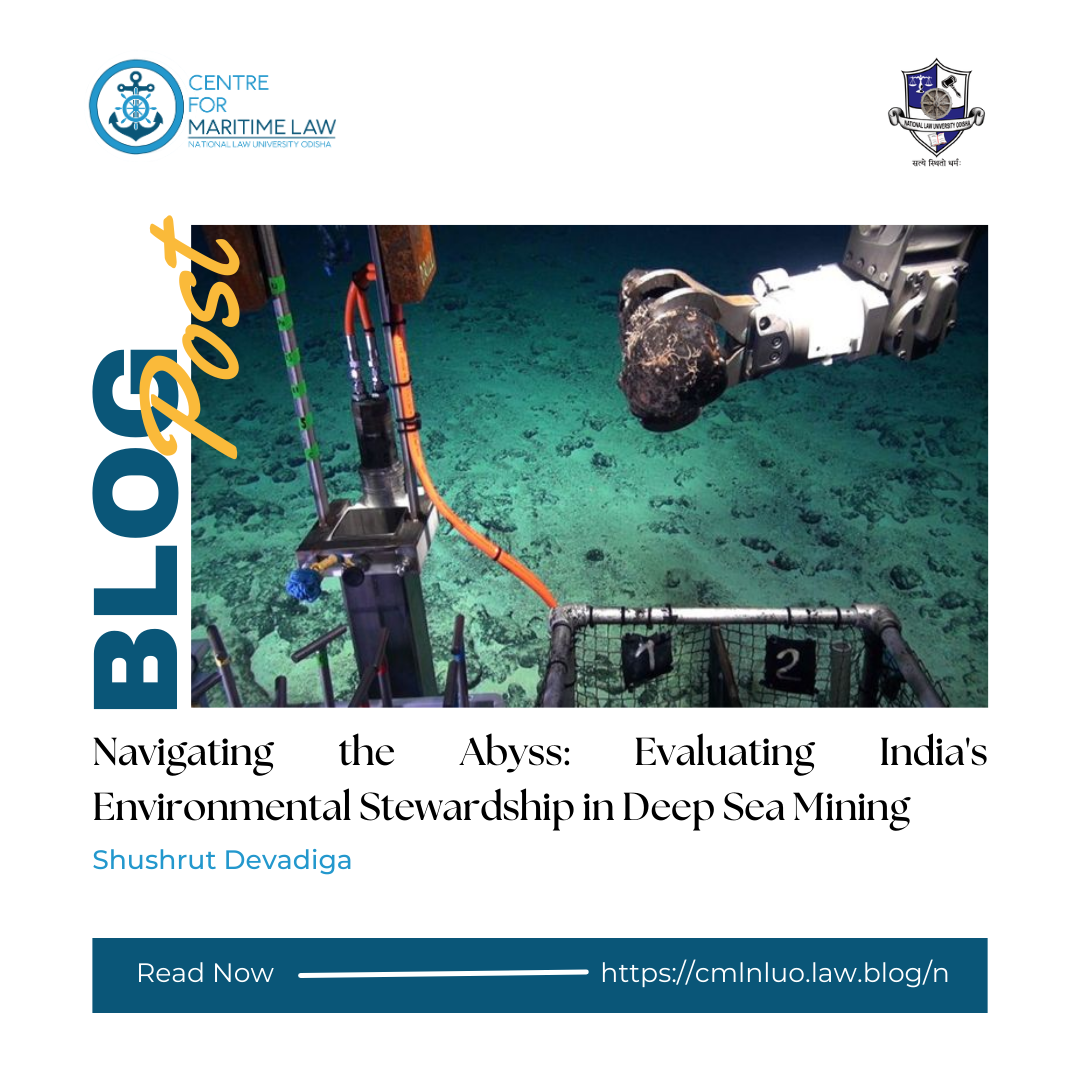
By Sushrut Devadiga
Introduction
The world stands at the precipice of a potentially transformative yet ecologically dangerous undertaking in the form of deep-sea mining. As humanity depletes its terrestrial deposits of critical minerals such as lithium, nickel, and cobalt required for the “green” transition, deep sea mining offers to solve this crisis by opening up the untapped depths of the deep sea for resource extraction.
Like many other countries, India has joined the race to the bottom of the seafloor, with the nation developing deep-sea mining technologies and resource exploration through its Deep Ocean Mission, for the explicit goal of future commercial exploitation. While nations await for the International Seabed Authority’s formulation of a commercial exploitation code to comence commercial mining in “the Area” the seabed beyond any national jurisdiction), they virtually have a free reign to exploit seabed within their owns jurisdictions.
Yet despite the excitement, deep sea mining also poses an enormous risk to the fragile environment of this isolated and relatively unknown ecosystem. Without adequate national regulations, India risks turning its Mission into a deep ecological nightmare.
Understanding Deep Sea Mining
Deep sea mining refers to the retrieval of valuable minerals from the seabed, typically occurring at depths deeper than 200 meter. The proposed method for such extraction involves mining the seafloor through the use of large automated machines, akin to land strip mining, which would then pump the excavated material to the ship while dumping the waste and debris back into the ocean. Mineral interests also plan to target three types of deposits: (a) polymetallic modules, containing mixtures of various metals including iron, copper, cobalt, nickel, etc, from abyssal plains (underwater plains); (2) cobalt crusts from seamounts (underwater mountains); and (3) polymetallic sulphides containing rich in minerals like copper, iron, zinc, silver and gold from hydrothermal vents.
The potential environmental impact in this largely unknown and untouched environment could be disastrous. Areas which are of commercial interest are known to be highly biodiverse, and many of the species inhabiting this region, most of which are new to science, might face extinction due to deep-sea mining. The pollution generated in this silent and isolated ecosystem may trigger a host of symptoms that negatively affect species.
Along with the destruction of this habitat, the mining devices and discharge pipes will release sediment plumes, which can travel for several kilometres away from the mining sites and might affect international fisheries by threatening species crucial for this industry. This potential environmental pandora box has led several scientists and organisms to demand a moratorium on deep-sea mining, though it is deemed likely considering our continuing demand for the minerals mentioned above.
The International Framework
Domestic regimes govern deep-sea mining within an Exclusive Economic Zone (EEZ). Article 56 of the United Nations Convention on the Laws of the Sea grants coastal states the sovereign rights to explore, exploit and manage natural resources within the seabed and subsoil within their EEZ, alongside the water column above the subsoil. States have a general obligation to safeguard the marine environment and to exercise their sovereign rights responsibly when exploiting resources, in accordance with their duty to uphold environmental preservation. States must further must take necessary measures to regulate marine environmental pollution from various origins, ensuring that such pollution is contained within their jurisdiction and does not inflict harm on other states Furthermore, Article 208 mandates coastal states to to establish laws and regulations for the management of maritime pollution arising from seabed activities within their jurisdiction which not only meet the effectiveness of current international rules, standards, and practices but also align with them
Article 211 requires states, in concert with international organisations or conferences, to establish international rules to regulate pollution from vessels, and provides powers to regulate it within their territorial waters. Crucially, within an EEZ, a coastal state is limited to enacting laws that align with internationally recognized regulations established by competent authorities or conferences, though in allowed to adopt special regulations in case the previously mentioned international standards are inadequate.
Seafloor outside natural jurisdiction (referred to as “the Area”) is governed by Part XI of UNCLOS. Declared as the “common heritage of mankind” by article 136, no nation can assert sovereignty over the Area or its resources by virtue of article 137, as these rights are vested in mankind acting through the Authority, i.e. the International Seabed Authority (ISA), established in Section 4 of Part XI.
Domestic Regulations
The primary legislation governing Deep Sea Mining in India is the Offshore Areas Mineral (Development and Regulation) Act, 2002 (OAMR Act), which sets forth the legal structure for the issuance of permits, licenses, and leases to facilitate the exploration and extraction of minerals in the country’s offshore regions. The statute was recently amended in 2023.
The Act applies to all minerals found in the offshore areas, which encompasses the waters included in the Territorial Waters, Continental Shelf, Exclusive Economic Zone and Other Maritime Zones Act, 1976. Under the act, exploration and mining operations cannot be undertaken without the requisite permit, license or lease. The government can grant such operating rights only to an Indian national or company defined under the Companies Act, 2013, that satisfies the prescribed condition.
The grant of composite licence (which refers to an exploration licence-cum-production lease) and production lease, following the 2023 amendment, is to be done through an auction process through a procedure prescribed by the Central government, subject to them fulfilling both conditions specified in the act and those prescribed. Production lease can be granted only after adequate establishment of the existence of mineral resources. Composite licensee can be granted one or more production lease/s after fulfilling the above condition through their exploration operations.
The legislation also includes specific provisions aimed at safeguarding the environment. Section 16A establishes Offshore Areas Mineral Trust, whose purpose is to use its funds for (a) research and administration related to offshore areas and adverse impact on its ecology due to operations being undertaken; (b) provision of relief in case of disaster within offshore areas; (c) for exploration of offshore areas; (d) to provide compensation to person affected by exploration and production operations in offshore areas; and (e) any other prescribed purpose. Section 19A places a duty on the central government to (a) conserve and systematically develop minerals in offshore minerals; and (b) safeguard the offshore environment by either preventing or regulating pollution resulting from mining activities. Section 20 requires holders of operating rights to conduct their operations in compliance with the provisions outlined in this act and the rules established within this statute or any other relevant legislation aimed at environmental protection, pollution prevention, and management. The government further possesses the authority to revoke operating rights and shut down areas under such rights in order to preserve the natural environment and prevent pollution.
Incompatibility of Allied Environmental Regulations
Though Section 20 requires holders of operating rights to follow all laws, rules and regulations for environmental protection, since deep sea mining is a nascent industry, many of these laws do not contain language that necessarily deals with it.
Under the Environmental Impact Assessment (EIA) Notification, 2006, projects falling under Category ‘A’ necessitate compulsory environmental clearance from the Union Government, facilitated through the Ministry of Environment and Forests. For mining, areas greater than or equal to 50 hectares come under this category. Under the OAMR Act, the area under licenses and lease consists of contiguous standard blocks, whose area is defined as one-minute latitude by one-minute longitude which is equivalent to roughly 271 hectares. However, the processes under the notification itself are inadequate, especially for deep-sea mining. Under the “scoping” process, the Expert Appraisal Committee (EAC) issues Terms of Reference (TOR) for the preparation of EIA. But in the majority of the cases, TOR is given based on the sector without considering the unique features of the area. This is problematic when analysing the deep sea environment considering how radically different it is from other marine environments along with the lack of scientific knowledge. Furthermore, the EIA report itself shall be formed by the project proponent, creating a conflict of interest as they are likely to downplay the adverse impacts of their own projects. The public consultation process may also be inadequate. The notification requires it to be conducted “site or in its proximity- district wise”, which seems extremely limited considering the scope of deep-sea mining, and the large area affected by plumes.
Hazardous and Other Wastes (Management & Trans boundary Movement) Rules, 2016 (hereinafter referred to as Hazardous Waste Rules) regulates the handling and disposal of hazardous waste. It places a duty on the occupier to undertake the following steps while managing hazardous waste: “(a) prevention; (b) minimization; (c) reuse, (d) recycling; (e) recovery, utilisation including co-processing; and (f) safe disposal.” It places further responsibility on the occupier for the safe and environmental management of their wastes. Additionally, the occupier is required to take all steps to “contain contaminants and prevent accidents and limit their consequences on human beings and the environment” while handling both hazardous and other waste. The rules also provide provisions for the compulsory requirement of authorisation for handling hazardous and other substances and the creation of facilities for the treatment, storage and disposal of hazardous and other materials. However, it is doubtful whether the biggest environmental hazard of deep-sea mining, the sediment plumes, will be covered under this rule. It defines a hazardous substance as “any waste which because of characteristics such as physical, chemical, biological, reactive, toxic, flammable, explosive or corrosive, causes danger or is likely to cause danger to health or environment, whether alone or in contact with other wastes or substances” and includes certain substances inscribed within Schedule I and II.
While it can be argued that sediment plumes, due to their physical nature, are dangerous to the environment due to their adverse ecological environment, it is not included in the schedule. Materials of similar composition have been held not to be hazardous materials. For example, drill cuttings (soil and rock fragments or particles removed from a borehole) from water-based mud, have been removed from the list of hazardous materials by the Ministry of Environment, Forest and Climate Change. The plumes will not come under the definition of other wastes as it has been defined as “wastes specified in Part B and Part D of Schedule III for import or export and includes all such waste generated indigenously within the country”.
Conclusion
Considering the potentially catastrophic risk posed by deep-sea mining to the fragile environment of the ocean floor, it is necessary to have a robust regulatory framework to regulate such pollution. There is an international mandate for such regulations, with the UNCLOS mandating states to control pollution originating within their jurisdiction and to prevent its transnational spread. However, Indian regulations are severely lacking in this regard even though the Government wants to push ahead with its plan to develop the “blue economy”. The OAMDR does in theory, have provisions to adequately regulate this industry through some of its stringent provisions. But, as highlighted through the delegation within the act, these statutory provisions need to be backed up with prescription-sufficient rules and notification. However, even with the recent amendment, the government has yet to promulgate any regulation under the act.
Furthermore, even though OAMDR includes provisions for the application of environmental regulations from outside statutes, they are lacking or were framed before the advent of deep-sea mining. The EIA Notification, 2006 is plagued with various issues with is unlikely to be rectified anytime in the future, as seen with the draft EIA Notification 2020. The Hazardous Waste Rules may not even be applicable due to its categorisation of hazardous and other wastes. Therefore continued vigilance by civil society and the citizenry is required to hold the government accountable and ensure compliance with international obligations.
 Centre for Maritime Law