

By Anunay Bhardwaj and Amritanshu Rath
Introduction
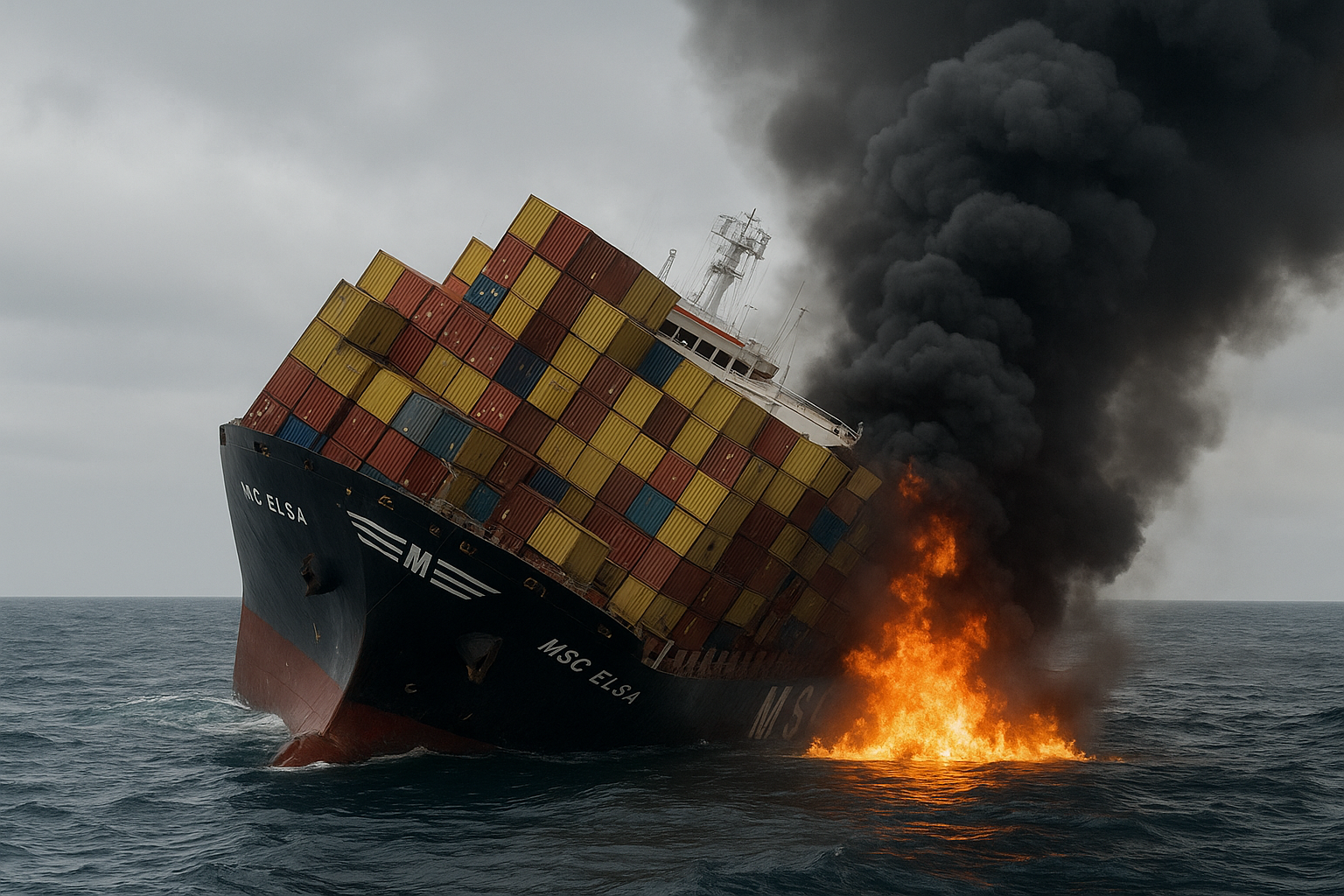
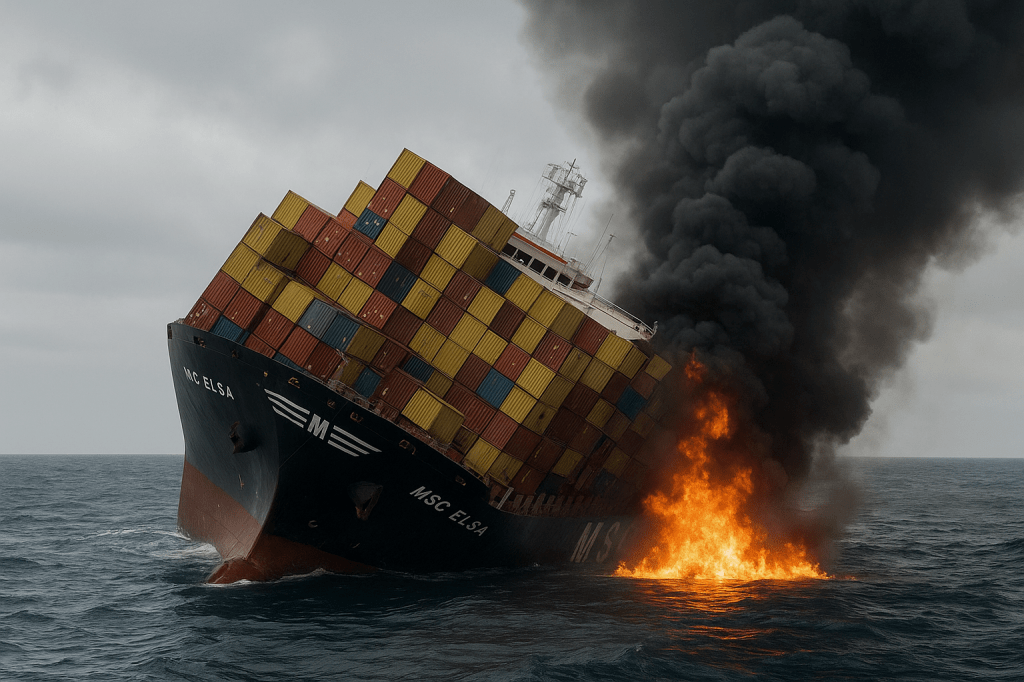
On 25th May 2025, the Liberian-flagged container ship MSC ELSA 3 capsized and sank about 38 Nautical Miles (NM) off Kochi, India. The vessel was 184 m Long and was carrying around 640 Containers, which had around 13 hazardous substances, including Calcium Carbide and tonnes of diesel and heavy fuel oil.[1] Although all 24 crew members were rescued, the sinking released toxic cargo. This incident triggered widespread pollution concerns. In response, the Indian Government imposed a 20NM fishing ban around the wreck.[2] At the IMO, India called for a review of container ship incidents, noting that recent cases “caused by undeclared hazardous cargoes” raised serious safety concerns.[3] Along with all these, the disaster has exposed the stark gaps in India’s maritime laws and response.
Comparative Failures: Where India Lags
India’s maritime environmental framework starkly lags global norms. Notably, India has not ratified key liability conventions, the Bunker Oil, Wreck Removal, and HNS Conventions, creating a “legal vacuum” in compensation regimes.[4] By contrast, Canada and the US have implemented comprehensive liability regimes: Canada’s Marine Liability Act implements the 2010 HNS Protocol and funds (up to SDR 250 million) for hazardous cargo losses[5], and the USA enforces the Oil Pollution Act (1990) with its Oil Spill Liability Trust Fund. India relies instead on the 1958 Merchant Shipping Act and ad hoc courts. For example, a recent official noted that without the Bunker Convention, India “has no direct mechanism to compel owners or insurers” to pay for fuel spills.[6] Similarly, India’s sole civil remedy for wreck removal is through domestic law, whereas Norway and others operate under the Nairobi Wreck Removal Convention or bilateral plans (e.g., Norway’s Norbrit plan with the UK) that automatically obligate owners to remove sunken wrecks.[7]
In practice, Indian victims must resort to admiralty arrests and lawsuits to seek redress. Under the Admiralty Act, 2017, claimants can arrest a vessel for “damage caused by the vessel to the environment”.[8] But arresting a ship is slow and uncertain; by comparison, Canadian or U.S. claimants often draw on statutory industry funds without arresting the ship.[9] For instance, Canada’s Ship-source Oil Pollution Fund (SOPF) is accessible to any affected party, with no cap on compensating pollution damage. India has no equivalent spill-response fund, so the entire financial burden falls on the state or private claimants unless owners are forced (and able) to pay. Experts warn this 20th-century toolkit is inadequate for 21st-century container disasters.[10]
India’s operational readiness is also weaker. The MSC ELSA-3 case exposed the near-absence of Tier-1/2 spill resources at Indian ports.[11] Neither Vizhinjam nor Cochin had ocean-going tugs or equipment to fight fires or spills.[12] By contrast, Singapore’s MPA maintains extensive industry stockpiles and has private OSROs (Oil Spill Response Limited, etc.) pre-positioned with booms and skimmers.[13] South Korea mandates that large ships stockpile oil spill gear on board or contract with KOEM, a coastguard-affiliated spill-response company.[14] Norway’s Coastal Admin (Kystverket) runs 27 national spill depots and requires oil companies (via the NOFO fund) to keep rigs and ports on high alert.[15] In India, no Tier-3 national stockpile exists, officials cite only OSRL centres in Singapore and Bahrain as nearby sources and even basic coastal cleanup (booms, neutralizers) was “late and limited”.[16]
Enforcement and coordination fare worse. India’s National Oil Spill Disaster Contingency Plan (NOSDCP) is largely aspirational: drills, data-sharing, and clear command lines rarely kick in. By contrast, the U.S. has the National Contingency Plan with 16‐agency Regional Response Teams and Joint Plans with neighbours (e.g. US–Canada, US–Mexico) for oil/HNS incidents.[17] Singapore requires every oil/HNS terminal to file approved contingency plans, with annual exercises up to Tier-3 scale.[18] In India, however, port-state control is understaffed and disjointed; as one analyst lamented, single inspectors are coping with “complex vessels” and there is no mandate for ports to maintain tow tugs or booms. The result is a reliance on ad hoc arrests and criminal FIRs (as seen in ELSA-3) rather than a systematic response.
In sum, India’s legal and operational regime falls far below peer practice. It lacks robust liability pools, dedicated response agencies, mandatory cargo transparency, and international coordination that others enjoy.[19] This comparative lag leaves India “ill-equipped to handle plastic spills and wreck removal” and facing “deeper institutional shortcomings” that the ELSA-3 disaster painfully exposed.
What India Could Have Done Differently
In retrospect, India could have pre-empted much of this crisis through legal and institutional reform. First, ratifying international conventions would plug critical gaps. Accession to the Bunker, Wreck Removal, and HNS Conventions would have automatically created shipowner liability limits and industry funds for spill cleanup and wreck removal. For example, if India had joined the Bunker Convention, any oil spill (even from ship fuel) would be covered by compulsory insurance and direct claims to owners, a mechanism absent under MARPOL alone.[20] If the 2010 HNS Protocol were in force domestically, the 12 calcium-carbide containers on ELSA-3 would fall under a strict liability regime with a supplementing international fund up to SDR 250 million.[21] Instead, India must rely on piecemeal domestic law and uncertain claims. The Merchant Shipping Act, 1958, should be amended to incorporate these international conventions, as seen in Canada and Japan, ensuring that shipowners are automatically liable for cleanup costs and that victims have direct access to global compensation funds.
Second, India needed better preparedness infrastructure. Each major port should maintain Tier-3 spill assets (long booms, skimmers, dispersant, etc.) and dedicated tugs on standby, an idea now advocated by policymakers. In practice, India could create a national stockpile (at Kochi, Mumbai, Chennai) or contract regional OSROs to store gear locally, rather than waiting 48–72 hours for foreign aid.[22] Similarly, a coordinated salvage capability must be built. This could mean formal agreements with private salvors and rail-type pre‐approved response teams, paralleling Singapore’s OSRL partnership or Korea’s KOEM membership scheme.[23][24] National contingency exercises, now largely theoretical, should be regularly mandated and audited to ensure functional coordination among the Navy, Coast Guard, ICG, and port authorities.
Third, regulatory fixes are crucial. India should enforce compulsory hazardous-cargo disclosure and stiff penalties for violations. Currently, shippers face little deterrent to mis declaring dangerous goods; experts note “no transparency in the data about what is in the containers”.[25] By contrast, many ports now fine shippers for false declarations (e.g. $15,000 per container) and ban non-compliant cargos. India can adopt similar rules under the MSA and IMO/IMDG Code. Even better, carrying undeclared HAZMAT should be made a specific offence, akin to MARPOL’s criminal penalties, to make shipowners or agents criminally liable for endangering life and the environment. India should treat the non-disclosure or misdeclaration of hazardous cargo as a criminal offence, backed by stringent prosecution and substantial fines, rather than leaving it to civil liability alone.
.
Fourth, India needs an institutional overhaul. A dedicated maritime‐environment agency or task force, ideally under the Coast Guard or Ministry of Shipping, should be given statutory powers. This body would unify NOSDCP implementation, intelligence‐sharing, and enforcement (reminiscent of Norway’s Kystverket or the U.S. Coast Guard’s pollution branch). It could maintain the national spill stockpile and even have on-call inspectors at ports. Bilaterally, India should negotiate joint contingency plans and enforcement treaties with neighbours (similar to the US–Canada Joint Plan[26] and Arctic Council arrangements) to share resources and legal authority in a crisis. For example, a joint India–Sri Lanka pollution protocol could allow Sri Lankan tugs or boom to respond off Kerala with Indian approval.
Conclusion: The Real Wreckage is Legal
The physical wreck of MSC ELSA-3 will be cleared, but India’s regulatory wreckage remains. This accident reveals more than an environmental toll; it exposes systemic legal and institutional failings. In the words of analysts, India was “attempting to manage 21st-century maritime risks with a 20th-century legal toolkit”.[27] The sinking of MSC ELSA-3 is not merely a story of a vessel lost at sea but a mirror held up to India’s out dated maritime governance. What emerges clearly is that India is attempting to manage complex, hazardous, 21st century maritime realities with a toolkit designed for a different era. Without urgent reform, accession to global conventions, mandatory cargo accountability, beefed-up spill infrastructure, and new enforcement mechanisms, ELSA-3 will be remembered not just for plastics on the beach, but for how it laid bare India’s anachronistic maritime laws. The ELSA-3 disaster should not fade as just another maritime accident but must be remembered as a turning point. The true cost of this disaster will be counted in lessons learned and laws changed, lest the next shipwreck be more than just another hull at sea. The real danger is not what the tide carried in, but what the law failed to carry forward.
[1] carrying 640 containers The Liberia-flagged vessel MSC ELSA 3 and others, ‘Twin Ship Disasters in India Threaten Widespread Pollution on Sri Lankan Coasts’ (Mongabay Environmental News, 19 June 2025) <https://news.mongabay.com/2025/06/twin-ship-disasters-in-india-threaten-widespread-pollution-on-sri-lankan-coasts/> accessed 21 July 2025.
[2] ‘India’s Kerala State Seeks $1.1 Billion in Compensation from MSC over Oil Spill | Reuters’ <https://www.reuters.com/sustainability/climate-energy/indias-kerala-state-seeks-11-billion-compensation-msc-over-oil-spill-2025-07-08/> accessed 21 July 2025.
[3] ‘India Urges IMO to Review Maritime Incidents Involving Foreign-Flagged Container Vessels | Today News’ <https://www.livemint.com/news/india/india-urges-imo-to-review-maritime-incidents-involving-foreign-flagged-container-vessels-11752064049311.html> accessed 21 July 2025.
[4] http://www.ETInfra.com, ‘Non-Ratification of Three Global Conventions Puts India in Legal Blind Spot after MSC ELSA-3 Disaster, ETInfra’ (ETInfra.com) <https://infra.economictimes.indiatimes.com/news/ports-shipping/non-ratification-of-three-global-conventions-puts-india-in-legal-blind-spot-after-msc-elsa-3-disaster/121727622> accessed 19 July 2025.
[5] Environment and Climate Change Canada, ‘Compensation for Losses and Damage Resulting from the Incidents Involving Dangerous Goods Carried by Ships: 2010 HNS Protocol’ (18 August 2022) <https://www.canada.ca/en/environment-climate-change/corporate/international-affairs/partnerships-organizations/compensation-dangerous-goods-ships.html> accessed 19 July 2025.
[6] http://www.ETInfra.com (n 4).
[7] ‘Norway – ITOPF’ <https://www.itopf.org/knowledge-resources/countries-territories-regions/norway/> accessed 20 July 2025.
[8] Phoenix Legal-Gautam Bhatikar, Shruti Salian and Vikram Kamath, ‘Q&A: Ship Arrest in India’ (Lexology, 19 June 2024) <https://www.lexology.com/library/detail.aspx?g=fb617b0e-2058-4759-803e-16b3cfcb1aae> accessed 20 July 2025.
[9] Transport Canada, ‘Marine Liability and Compensation: Oil Spills’ (AH 16052025, 12 September 2024) <https://tc.canada.ca/en/marine-transportation/marine-safety/marine-liability-compensation-oil-spills> accessed 20 July 2025.
[10] http://www.ETInfra.com (n 4).
[11] ‘India’s Maritime Crisis: Calls for National Oil Spill Response Stockpile After MSC ELSA 3 Sinking, ETInfra’ <https://infra.economictimes.indiatimes.com/news/ports-shipping/indias-maritime-crisis-calls-for-national-oil-spill-response-stockpile-after-msc-elsa-3-sinking/121970571> accessed 20 July 2025.
[12] ibid.
[13] ‘Singapore – ITOPF’ <https://www.itopf.org/knowledge-resources/countries-territories-regions/singapore/> accessed 20 July 2025.
[14] ‘Korea – Republic of Korea (South Korea) – ITOPF’ <https://www.itopf.org/knowledge-resources/countries-territories-regions/korea-republic-of-korea-south-korea/> accessed 20 July 2025.
[15] ‘Norway – ITOPF’ (n 7).
[16] ‘India’s Maritime Crisis: Calls for National Oil Spill Response Stockpile After MSC ELSA 3 Sinking, ETInfra’ (n 11).
[17] ‘United States of America – ITOPF’ <https://www.itopf.org/knowledge-resources/countries-territories-regions/united-states-of-america/> accessed 20 July 2025.
[18] ‘Singapore – ITOPF’ (n 13).
[19] ‘Oil and Plastic Pollution from Shipwreck Raises Concerns, Legal Scrutiny in India’ <https://news.mongabay.com/2025/07/oil-and-plastic-pollution-from-shipwreck-raises-concerns-legal-scrutiny-in-india/> accessed 20 July 2025.
[20] http://www.ETInfra.com (n 4).
[21] Canada (n 5).
[22] http://www.ETInfra.com (n 4).
[23] ‘Korea – Republic of Korea (South Korea) – ITOPF’ (n 14).
[24] ‘Singapore – ITOPF’ (n 13).
[25] ‘Oil and Plastic Pollution from Shipwreck Raises Concerns, Legal Scrutiny in India’ (n 19).
[26] ‘United States of America – ITOPF’ (n 17).
[27] http://www.ETInfra.com (n 4).
 Centre for Maritime Law