

By Chinmaya Vidyadhar Joshi
Introduction
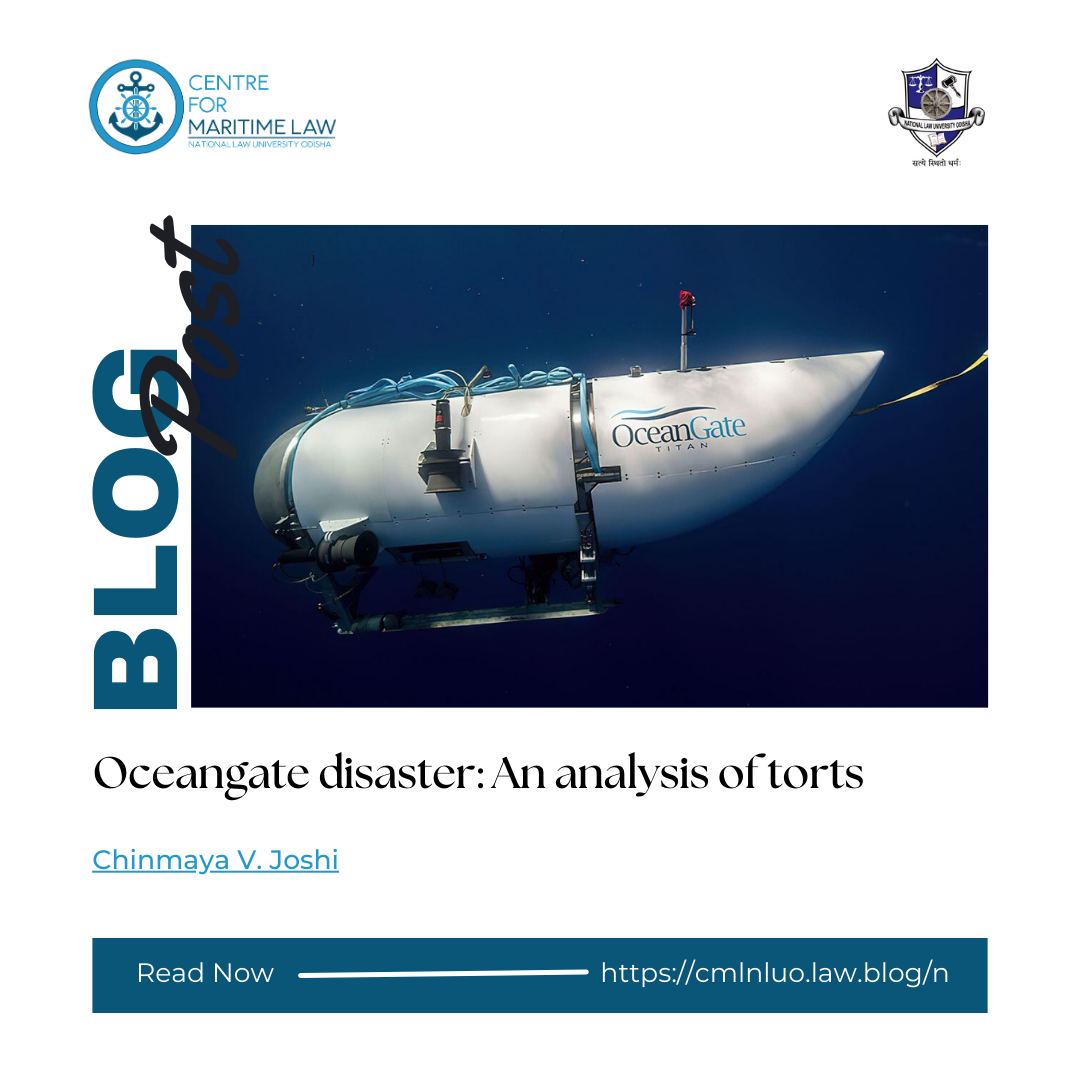
In June 2023, Titan, a submarine owned by Ocean-gate, an American tourism and expeditions company, imploded on its way towards the wreckage of the Titanic. The implosion instantly killed all the passengers in the submarine. It is an infamous tragedy and a maritime disaster that led to the gruesome death of five passengers – one of them being the CEO of Oceangate. This incident raised serious concerns about the submarine and the general safety measures surrounding maritime expeditions. It ventures into the conflicting domains of negligence and the idea of volunti non fit injuria, which means if one signs up for an inherently dangerous activity, one cannot complain against its harmful/injurious consequences.
Negligence v. waiver
Before putting forth a concrete answer to the above tussle, it is crucial to understand some jurisprudence behind the two terms. There is a subtle difference between intention, negligence and recklessness, although they may all be used interchangeably. Intention is present in one’s mind. It is the driving force behind one’s action. It determines ‘how’ the action will be performed. On the other hand, negligence means that you did not know the consequences of your actions while you performed them. The consequences could have been foreseen, but they were not. However, recklessness is the furtherance and an extreme angle of negligence wherein you know the consequences of your actions. Still, you depict indifference towards them or are willing to take the risk arising from those consequences.
For instance, referring to the Judicial Officers Protection Act of 1850 brings out a tint of this demarcation. The Act comprises only one section[1] and provides immunity to the judicial officers who acted in good faith while performing their judicial duties. According to Westropp J.,[2] a magistrate cannot claim that, at the time of the incident, he acted in good faith, believing that he had the authority to carry out the act that was complained of if he fails to exercise reasonable, cautious, and circumspect behaviour in the performance of his duties, or, to put it another way, behaves recklessly in violation of clear or well-known rules of law or procedure.
The counter to negligence is a waiver of liability agreement. The passengers had signed a waiver agreement that absolved the Company of any prospective liability arising from a mishap and contained the word ‘death’ multiple times.[3] The idea of waiver is based on the principle of volunti non fit injuria, which means that one who has willingly invited harm to himself cannot complain of the harmful action. Note that this principle is based not on the formation of a contract but on the soundness or mental capacity of the affected person. Mere acceptance of all the risks by a participant in a sporting event does not blanketly eliminate the indispensable duty of care towards each other.[4] The organiser’s liability would be determined based on industry standards for conducting such sporting activity. Industry customs and the game’s regulations must be considered when deciding whether a game organiser has violated its obligations to a hurt participant. This is because they help determine what the threshold of reasonableness needed.[5] These case laws show that the reasonableness in the defendant’s conduct would be a defence to negligence charges.
Safety Lapses
Several news reports have highlighted that the Titan submarine had yet to receive a full-fledged regulatory clearance for venturing into this voyage. A previous lawsuit was filed by a former employee of Oceangate, who was terminated from employment for raising his voice against the safety hazards of the submarine. He was wrongly fired for raising concerns over the company’s “refusal” to perform essential tests on the submersible’s hull.[6] Furthermore, the Titan’s manufacturer claimed that because Titan was inherently an “innovation,” it was never subjected to a ‘standards review’ because, perhaps, it was the standard. In 2019, OceanGate said that features on its Titan submarine would need years to get approval.[7] Therefore, the Titan submersible isn’t officially certified. Numerous things are called into question by the Titan’s design. The single window meant for viewing the Titanic wreckage was embedded in a door that provided entry to the submersible. There was no way to open this entry door from inside the submarine, which evinces that it would be a havoc to eject during an emergency. Note that the intricate construction of the access hatch necessitates the laborious loosening of seventeen bolts. This is a drawn-out procedure that is not good in an emergency. The submarine body was predominantly made of carbon fibre. A beneficial feature of this material is that it is lighter than steel or titanium. However, since carbon fibre may shatter readily and abruptly, its properties in deep water applications are unknown.[8] Hence, the Titan was designed experimentally.[9] Also, the overall build of the submarine was comprised of generic, off-the-shelf materials from not-so-specialist shops. This fact, as reported by CNN,[10] is enough to hold the company liable on the counts of negligence or, rather, recklessness.
Conclusion
From the above security lapses, it is crystal clear that the deceased persons’ families can initiate legal action. The families are considering the option of starting legal action at the moment. OceanGate has suspended all its operations ad infinitum. In such cases, not initiating a legal action, where the death has been so gruesome and unnatural, would set a bad precedent. The US Coast Guard has been proactive in search and rescue operations. Despite warnings from experts, a previous lawsuit filed by a former employee, and so on, the company paid no heed to the blatant and fatal dangers in the architecture of the submarine. Regardless, the courts have yet to take judicial notice of the happening and apply their legal minds to the disaster.
[1] §. 1. “Non-liability to suit of officers acting judicially, for official acts done in good faith, and of officers executing warrants and orders.—No Judge, Magistrate, Justice of the Peace, Collector or other person acting judicially shall be liable to be sued in any Civil Court for any act done or ordered to be done by him in the discharge of his judicial duty, whether or not within the limits of his jurisdiction: Provided that he at the time, in good faith, believed himself to have jurisdiction to do or order the act complained of; and no officer of any Court or other person, bound to execute the lawful warrants or orders of any such Judge, Magistrate, Justice of the Peace, Collector or other person acting judicially shall be liable to be sued in any Civil Court, for the execution of any warrant or order, which he would be bound to execute, if within the jurisdiction of the person issuing the same.”
[2] Vinayak. v Bai Itcha, (1865) 3 BHC (ACJ) 36, 46.
[3] Eric Snodgrass, The company that operates the missing Titanic sub is likely protected from future lawsuits thanks to the ‘tons of risk’ that passengers incurred, legal experts say, Business Insider, (accessed on Feb. 24, 2024 13:51), https://www.businessinsider.com/oceangate-likely-protected-from-titanic-sub-lawsuits-legal-expert-2023-6?IR=T.
[4] Rootes v. Shelton, (1968) ALR 33.
[5] Woods v. Multi Sports Holdings Pty. Ltd., (2002) 76 ALJR 483.
[6] Oceangate v. David Lochridge, Case No. 2:18-cv-01083-RAJ.
[7] Why Isn’t Titan Classed?, OceanGate Blog Post, (accessed on Feb. 24, 2024, 15:55), http://web.archive.org/web/20200807162348/https://oceangate.com/news-and-media/blog/2019-0221-why-titan-is-not-classed.html. Please note that the original URL is no more accessible.
[8] Ibid.
[9] Mohsien Hassim, Ocean Gate Titan – Risk Management – the lessons learned, LinkedIn, (accessed on Feb. 24, 2024, 16:30), https://www.linkedin.com/pulse/ocean-gate-titan-risk-management-lessons-learned-mohsien-hassim/.
[10] Helen Regan et. al., June 22, 2023 – Missing Titanic sub crew killed after ‘catastrophic implosion’, CNN, (accessed on Feb. 24, 2024, 16:55), https://edition.cnn.com/americas/live-news/titanic-missing-sub-oceangate-06-22-23/h_22c7164a7a2280113393fa3949f0e3ad.

